

Makeup looks different in photographs because the camera does not see the way your eye does. Your brain corrects for the colour of the light, fills in shadow, and looks at a face from a metre away; the camera guesses at the light, records whatever the flash reflects, flattens what it lights from the front, and is then viewed at close range on a large screen. Five things follow from that, and a bridal artist plans for every one of them at the trial.
1. The colour of the light
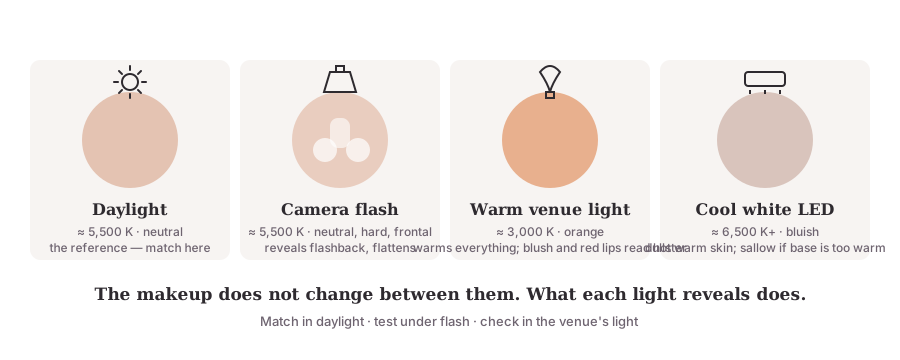
Every light source has a colour. Noon daylight is neutral, at roughly 5,200–6,000 kelvin. A camera flash is close to daylight, around 5,500 K. An incandescent bulb, a string light, a candle or a warm LED is orange, around 3,000 K; a cool white LED can run blue.
Your eye adapts: under a warm bulb, you still see a white shirt as white. The camera does not know what white is — it guesses, through a setting called white balance — and if the guess is wrong, skin comes out too warm, too cool, greenish or magenta.
This is why makeup applied under warm light goes wrong in photographs. Under a 3,000 K bulb, the eye stops seeing the orange; the artist chooses a shade or a blush that looks right in that light; the camera white-balances to daylight and the face is suddenly too warm, or the blush that looked soft is suddenly loud. The fix is simple and non-negotiable: match and check in daylight (or under daylight-balanced light around 5,000–6,000 K), and then look at the makeup under the venue's real light too.
2. Flash and flashback
A flash is a burst of hard, daylight-coloured light from the front. Anything on the face that reflects light sends it straight back into the lens — and two common ingredients reflect strongly: mineral sunscreens (zinc oxide and titanium dioxide, white powders that work by reflecting sunlight) and silica, the light-diffusing powder in HD setting powders. In normal light silica scatters light softly and blurs texture; under direct flash its many tiny surfaces act like a mirror ball and the camera records a white cast where the powder is thickest — under the eyes, across the T-zone.
The artist's rules: no SPF-heavy products on the face for flash-lit functions (a daytime outdoor function is a different calculation, decided with the bride); silica powder pressed only where needed with a fluffy brush; and one photograph under the phone's flash in a dim room at the trial. That single photograph catches flashback, a shade that goes pale, and a shimmer that reads as glitter.
3. Flash flattens
Your eye sees a face lit from above and the side — window light, ceiling light — with natural shadows under the cheekbones and along the jaw. An on-camera flash lights from the front and fills those shadows in. The face loses dimension; a soft daytime contour disappears entirely.
That is why bridal makeup is a touch stronger than daytime makeup: contour, blush and definition are built so the flash cannot flatten them — more blended, never darker at the edge. It looks slightly strong in the mirror at arm's length and exactly right in the album. Brides who ask for the makeup to be softened at the mirror often ask for it to be stronger after the first photographs; the trial photograph settles it in advance.
4. Distance and the lens
A wing that looks bold in the mirror at thirty centimetres reads as fine from the mandap at ten metres. A lip that looks intense close up reads as balanced in a full-length photograph. Distance reduces contrast, and the wedding photographer works at both ends — a close portrait and a wide shot of the pheras — from the same makeup. The artist splits the difference: definition that holds at a distance without looking heavy in a portrait, which again is a question of blending rather than quantity.
Lenses add their own effect: a wide lens close up enlarges whatever is nearest (the nose, the forehead); a long lens from a distance compresses and flatters. Neither is the makeup's fault, and a good photographer manages both.
5. The screen
A wedding album is now viewed at close range on a large, bright, high-resolution screen. Texture, an edge of foundation, a powdery crease that no guest at the wedding could see are visible on a phone held at arm's length. This is the reason the industry moved to thin, finely milled, light-diffusing products — the whole story of HD makeup — and the reason a heavy base photographs worse, not better.
What the artist does about all five
- Match the shade in daylight on the jaw and chest; check it again under the venue's light.
- Keep the base thin and set only where the skin oils; heavy powder photographs as chalk.
- Avoid SPF and heavy silica on the face for flash-lit functions; decide daytime sunscreen with the bride.
- Build dimension for flash: cream contour and blush under a light powder, blended until edgeless.
- Define for distance: a touch more liner, brow and lip definition than daytime, still soft at portrait range.
- Test: one flash photograph in a dim room, one daylight look at arm's length, at the trial and again before leaving on the day.
- Talk to the photographer about the venue's lighting plan; warm string lights and cool LED stage lights pull the face in two directions, and knowing which dominates changes the blush.
From Chhaya Yadav's experience
Observations from trials and weddings in Jaipur — professional observations, not statistics.
- The studio's LED panels are kind; the photographer's flash is not. Every trial ends with a flash photograph in the dimmest corner of the studio because the flash is the light the album will be made in.
- "My makeup looked lighter in the photos" almost always means sunscreen or silica. When I ask what was under the base, an SPF moisturiser is usually the answer.
- Palace and haveli string lights make everything orange. A lip that is a balanced red in daylight photographs warm under them; I choose the red knowing that.
- Brides ask me to soften the contour at the mirror and to strengthen it after the first photographs. The flash photo at the trial has ended that conversation for years.
- Distance flatters; screens do not. Thin, blended and defined is the only combination that survives both.
Frequently asked questions
Why does my makeup look lighter in photos? Usually flash meeting light-reflecting ingredients — mineral sunscreen (zinc oxide, titanium dioxide) or silica-heavy powder — which bounce the flash back and read as a pale cast. Sometimes it is simply a shade one step too light, which flash exaggerates.
Why does my makeup look orange or yellow in photos? Warm venue light — string lights, candles, tungsten bulbs — is orange, and the camera may not correct for it fully. A base that was slightly too warm becomes obviously orange under it. Matching in daylight and checking in the venue's light prevents it.
Why does the camera flatten my face? On-camera flash lights the face from the front, filling in the natural shadows that give it dimension, and distance reduces contrast. That is why bridal contour, blush and definition are a touch stronger than daytime makeup — blended, never darker at the edge.
What is white balance? The camera's adjustment for the colour of the light. Your eye corrects automatically; the camera guesses, and a wrong guess turns skin too warm, too cool, greenish or magenta. A good photographer sets it; a good artist avoids products that confuse it.
Should I wear sunscreen under wedding makeup? For a daytime outdoor function, a lightweight one — but tell your artist, because mineral sunscreens reflect flash. For evening functions under flash, most artists keep SPF off the face.
How do artists test makeup for photos? One photograph under the phone's flash in a dim room at the trial, plus a daylight check at arm's length. The flash photo catches flashback, a shade that goes pale, and shimmer that reads as glitter.
Key takeaways
- The camera guesses the colour of light; your eye corrects for it. Match and check in daylight, then in the venue's light.
- Flash reflects off mineral sunscreen and silica — the white cast called flashback. Keep both light on the face for flash-lit functions.
- Flash flattens and distance softens; bridal makeup is a touch stronger, and blended, for that reason.
- Screens magnify; thin, finely milled bases photograph best.
- One flash photograph in a dim room at the trial answers most of this in advance.
Related reading
- The Complete Bridal Makeup Guide · Jaipur Wedding Makeup Guide · HD, Airbrush or Traditional?
- On the academy site: What is HD Makeup? — the science of light-diffusing makeup and flashback
- Bridal makeup at Chhaya Shankar Makeovers